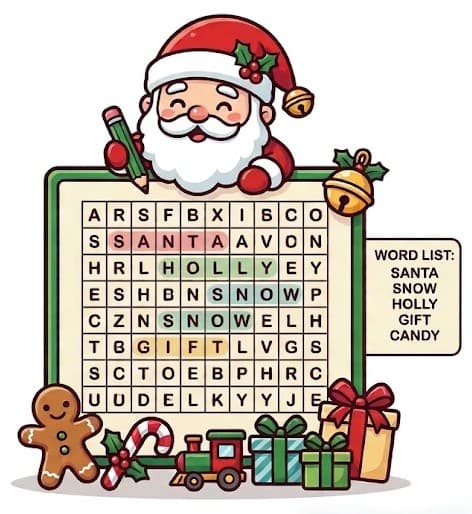
Festive Word Search Puzzles for Every Level
Our puzzles come in two levels, so everyone can join in.
Easy puzzles: Easy puzzles usually have shorter word lists and words that run in straight lines, such as across and down. They are a good start for younger readers, from about age 6.
Tricky puzzles: Tricky puzzles usually have longer word lists, and some words run backward or diagonally. They suit older children, from about age 8, and adults who enjoy a challenge.
Choose a level that feels fun, not frustrating. If a puzzle feels too hard, try an easier one first.
How to Solve a Word Search
If you are new to word searches, try these steps:
Read the word list before you start. Pick one word and scan the grid for its first letter. Check the letters around it in every direction: across, down, backward, and diagonally. Circle the word when you find it, then cross it off the list. Look for unusual letters, such as Z, Q, X, or J. They are easier to spot than common ones. Take a short break if you get stuck. Fresh eyes often spot the missing word. H2: Christmas Words Kids Will Find
Christmas word searches use words from the holiday, such as Santa, reindeer, snowman, stocking, gifts, star, and angel. Each word is also a chance to talk about the traditions behind it.
After finding a word, children can explore it in a coloring page. A child who finds “reindeer” can color one in our Reindeer Coloring Pages, and a child who finds “snowman” can try our Snowman Coloring Pages. Other favorites include Santa Claus Coloring Pages, Christmas Tree Coloring Pages, and Gingerbread Coloring Pages. For more learning practice, try Christmas Worksheets.
Why Word Searches Are Good for Kids
Word searches are fun, and they can also help children practice useful skills:
Vocabulary and spelling: Children see words written out letter by letter. Pattern recognition: They learn to spot a word hidden among other letters. Attention to detail: They must look closely at every letter. Focus and patience: Finishing a puzzle takes steady attention. Screen-free fun: A printed puzzle is a calm activity for quiet time.
Word searches are also easy to use at home and in school, and children can work alone or in teams.
A Short History of the Word Search
The word search puzzle is quite young. The first one is generally credited to Norman E. Gibat, who published it on March 1, 1968, in a small newspaper called the Selenby Digest in Norman, Oklahoma. The words in his first puzzle were names of Oklahoma cities, and they could run forward, backward, up, down, and diagonally.
Teachers loved the puzzles. Many wrote in to ask for more to use in their classrooms. Over time, the puzzle has been called by many names, including word find, word seek, and circle circle. Some historians note that a Spanish puzzle maker may have published similar puzzles earlier, so the true origin is still a little uncertain.
Ideas for Using Word Searches at Home and in Class
Advent countdown: Do one puzzle each day in December.
Party game: At a Christmas party, see who can finish a puzzle first, or work in teams.
Early finishers: Keep a stack of puzzles ready for students who finish work early.
Spelling practice: Ask children to write each word they find in a sentence.
Family time: Print a puzzle for the whole family and race to find all the words.
Make your own: Older children can design their own with words they choose.
Car rides and quiet time: Puzzles are an easy screen-free activity for travel.
English learners: Word searches are a helpful way to practice holiday vocabulary.
Printing Tips
Print on regular white paper. Cardstock is not needed. Print at 100% size so the letters stay easy to read. Avoid shrinking the page. Set your printer to High Quality. All pages fit US Letter (8.5 x 11 in) and A4 paper. Use a pencil, pen, or highlighter to mark the words.
Short Fun Facts – Word Search Puzzles 🔍
The first word search in English was published on March 1, 1968.
It appeared in the Selenby Digest, a small newspaper in Norman, Oklahoma.
Norman E. Gibat is generally credited with creating it.
His first puzzle used the names of Oklahoma cities.
Words could run forward, backward, up, down, and diagonally.
The name Selenby stood for “buy and sell.”
Teachers wrote in asking for more puzzles to use in their classrooms.
Word searches are also called word find, word seek, and circle circle.
A Spanish puzzle maker named Pedro Ocón de Oro may have published similar puzzles earlier.
Why Kids Love Christmas Word Searches
Word searches feel like a game, and finding a hidden word is exciting. Christmas puzzles add festive words and bring holiday fun to quiet time. Easy puzzles give younger children early success, and tricky puzzles offer a real challenge for older kids. Children practice spelling, focus, and pattern spotting without even noticing, and they get the satisfaction of circling the last word.


